Investigation - Frozen Yachts Sanctions : How the Superyacht Meridian A Revealed the Financial Secrets of a Putin Insider

Updated: Apr 17
Meridian A: how frozen yachts expose the limits of EU sanctions
Moored in Barcelona for over three years, the superyacht Meridian A sits in silence — a silence that reflects the ongoing tension between sanctions enforcement and the resilience of offshore financial structures.
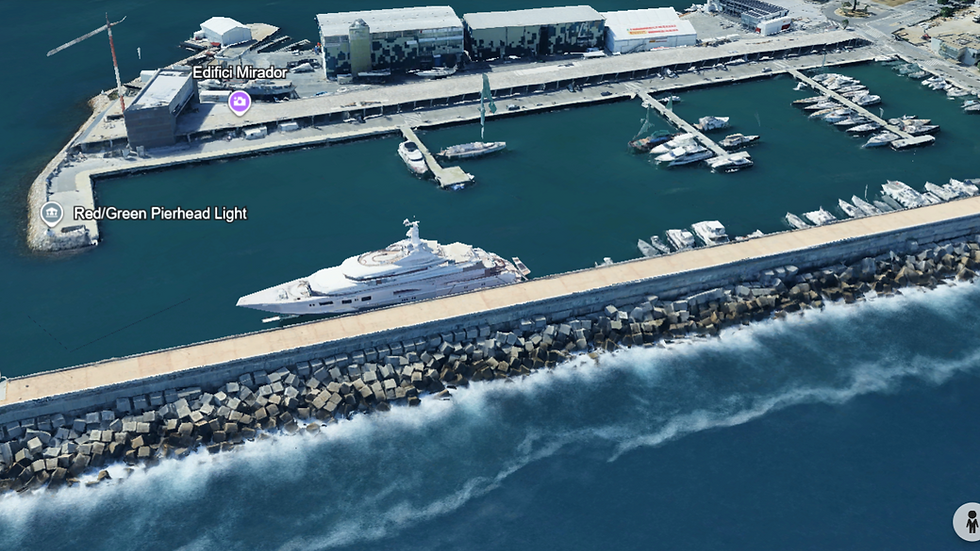
A yacht at the crossroads of investigations
The yacht has been described in public investigations, notably by OCCRP, as being linked - at the time of earlier documented ownership structures - to Anastasia Ignatova, a Russian-language professor and daughter-in-law of Sergey Chemezov, head of the state-owned conglomerate Rostec, supplier of approximately 80% of Russia’s weaponry. (Source: OCCRP)
More recent court proceedings, as reflected in The Kyiv Independent, indicate that she is likely no longer the formal owner of the vessel.
Beyond this initial attribution, the investigation conducted by Alisa Yurchenko (The Kyiv Independent, October 2025) focuses primarily on Sergey Chemezov and the network of relationships surrounding him.
It describes what may be understood as a broader pattern: nominee ownership, offshore layering, and legal strategies deployed across jurisdictions.
From KGB-era networks to offshore opacity
The Kyiv Independent investigation refers to the yacht’s “alleged connection to Sergei Chemezov”, noting that the asset is “linked to” him and that he “may have actually controlled” it.
Sergey Chemezov, a long-time associate of Vladimir Putin since their KGB years, has been subject to U.S. and EU sanctions since 2014, later extended to members of his family.
At the time reflected in earlier investigations, the yacht was registered in the name of Anastasia Ignatova, “whose profession as a Russian-language teacher did not suggest that she had the means to purchase a $140 million yacht.” (Source: OCCRP)
Her university salary was estimated at approximately $2,200 per month.
Behind this apparent discrepancy, OCCRP identified a layered offshore structure involving British Virgin Islands entities, including Sightview Consultants Ltd and Linkpoint Services Ltd, both revealed in the Panama Papers. (Source: OCCRP)
Successive nominees
Before Ignatova, the yacht - then named Valerie - was associated with Borys Kogan, an Odessa-based businessman involved in arms logistics.
Following his death in 2017, Spanish tax records reportedly indicated a transfer of ownership to Chemezov’s daughter-in-law. (Source: The Kyiv Independent)
The pattern that emerges is not unusual in such cases:
one asset, multiple formal holders, and a continuity that remains structurally opaque.
A backdated transaction?
In 2021, Russian billionaire Albert Avdolyan appeared in connection with the yacht. Madrid judges reportedly identified inconsistencies between:
a sale contract dated 2021
a bank transfer dated 2022
and documentation relating to beneficial ownership issued after sanctions were imposed
Spanish authorities highlighted what they described as a “striking time gap” between these elements.
According to the elements identified in the proceedings and as reported in public investigations, Avdolyan - a Russian businessman with major interests in the energy sector (coal and LNG), listed by Forbes - has been described as having business links to entities connected to Rostec.
In this context, Spanish authorities reportedly questioned whether the transaction could reflect a “simulated sale”. The proceedings on this matter remain subject to judicial review.
In February 2025, Avdolyan was added to the EU sanctions list.
According to publicly available data from Equasis (IMO 1010624), the yacht has been registered since January 2019 under Sulberg Services Ltd, a British Virgin Islands entity acting as both registered owner and commercial manager. However, such registries reflect formal ownership and management structures and do not, in themselves, determine the identity of the ultimate beneficial owner.
In practice, judicial asset management and disposal processes require a systematic analysis of beneficial ownership, control, and source of funds - as formal registries alone are insufficient to assess legal risk, enforceability, or transferability.
Legal offensives and parallel strategies
From 2022 onward, legal challenges were initiated:
in Spain, seeking to lift the seizure
before the Court of Justice of the European Union, seeking removal from sanctions lists
According to the investigation, these actions contributed to revealing further details regarding the ownership structure.
Simultaneously, Chemezov reportedly engaged U.S. lobbying firms - Rathmell Short LLP and Stryk Global Diplomacy - for $2.6 million under FARA disclosures, funded via a Dubai-based entity (Yudisud Tjong Trading LLC). (Source: U.S. FARA filings)
The objective appears twofold:
testing legal pathways in more flexible jurisdictions
potentially creating precedents usable in Europe
Circumvent to contend
As noted by Anastassia Fedyk (UC Berkeley):
“There are several reasons why individuals like Chemezov may seek to lift sanctions in the U.S., even if most of their frozen assets are in Europe.”
She adds:
“If they believe the U.S. administration is currently more inclined to lift certain restrictions, they may later use it as a precedent to challenge EU sanctions.”
To date, no confirmed easing of sanctions has been recorded. However, the proceedings have revealed additional layers of ownership and structuring.
European freeze, legal paralysis
Spanish authorities have pointed out a structural limitation: Circumventing sanctions is not, in itself, a criminal offense under Spanish law.
This leads to a critical distinction:
Freeze = asset immobilisation without transfer of ownership
Confiscation = legal transfer enabling disposal
The Meridian A case thus illustrates a systemic gap in European enforcement.
By contrast, the United States - through the KleptoCapture Task Force - has seized assets such as M/Y Tango (linked to Viktor Vekselberg), although forfeiture remains ongoing.(Source: U.S. Department of Justice, April 4, 2022)
Learning from Italy: reversing the burden of proof
Where beneficial ownership dissolves into offshore opacity, traditional evidentiary frameworks reach their limits.
The Italian Rognoni–La Torre law (Law No. 646/1982), now integrated into the Anti-Mafia Code (D.Lgs. 159/2011), provides an alternative:
confiscation based on disproportionality between assets and declared income
potential reversal of the burden of proof
Strictly supervised by the judiciary, this mechanism allows intervention without waiting for a criminal conviction.
Adapted at the European level, it could offer a decisive tool against concealed ownership structures.
Why this case matters
The Meridian A case highlights structural realities:
nominee ownership remains central to sanctions evasion
legal fragmentation weakens enforcement
asset freezes often fail to produce operational outcomes
As described by The Kyiv Independent, this creates a “legal fog of sanctions”:
immobilized assets
rising maintenance costs
progressive loss of value
What comes next
The investigation by Alisa Yurchenko sheds light on the complexity of Russian asset structuring and the limitations of current frameworks.
It confirms a simple truth:
A yacht is never just a yacht. It is a financial vehicle, a legal construct, and sometimes a strategic instrument.
France is now exploring structured approaches to the management and disposal of frozen maritime assets - combining legal rigor with operational efficiency.
As long as ownership remains legally intact, enforcement remains structurally incomplete.
In Short Freeze without confiscation is not enforcement. It is immobilisation without resolution. |
Contact
Emmanuelle VOTAT - Judicial Yacht Asset Manager (France) - Specialist in Seized Maritime Assets – ev@yachting-legal-auction.com
Frozen Yachts & Sanctions : Read the article in the Kyiv Independent October 7, 2025
This article is based on publicly available facts, verifiable data, and an independent legal and strategic analysis. It does not, under any circumstances, constitute a definitive statement regarding the guilt or innocence of the individuals or legal entities mentioned, but rather forms part of a general-interest reflection on the management of frozen or seized assets in a complex geopolitical context. Any correction or right of reply may be submitted through the appropriate official channels and will be given due consideration. The author acts in full independence and in compliance with the right to information and the duty of professional restraint.


